

Thermoforming vs Vacuum Forming
“Thermoforming” and “vacuum forming” are often used interchangeably, but vacuum forming is technically a subset of thermoforming. Understanding the distinction helps you ask the right questions when sourcing a plastic forming manufacturer.
VACUUM FORMING DEFINED
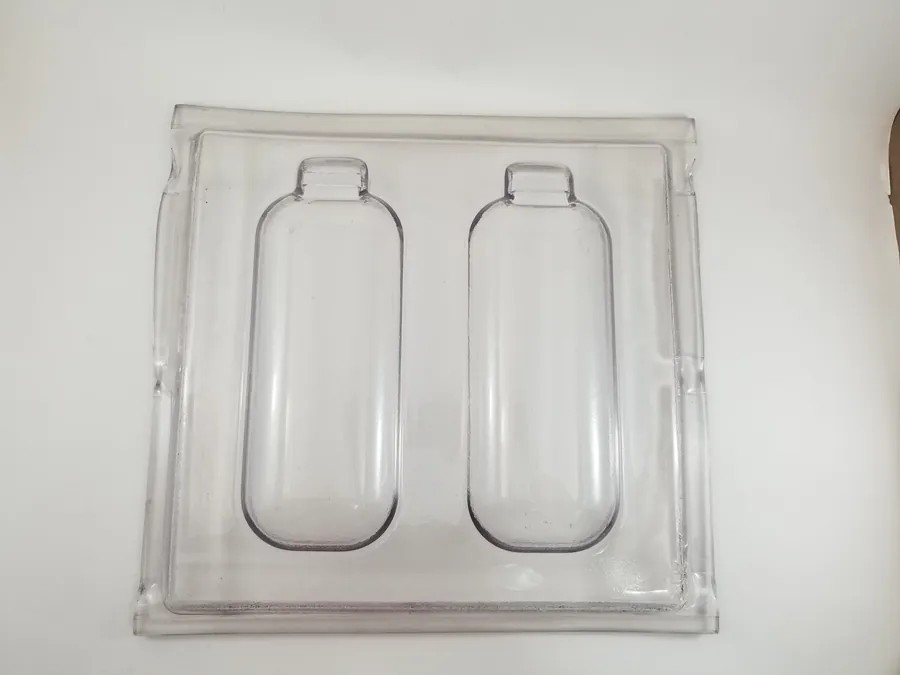
Vacuum forming uses negative pressure (vacuum) to draw a heated plastic sheet onto a mold. The vacuum pulls the softened sheet tight against the mold surface. It is the simplest form of thermoforming and is widely used for packaging, trays, and simple enclosures.
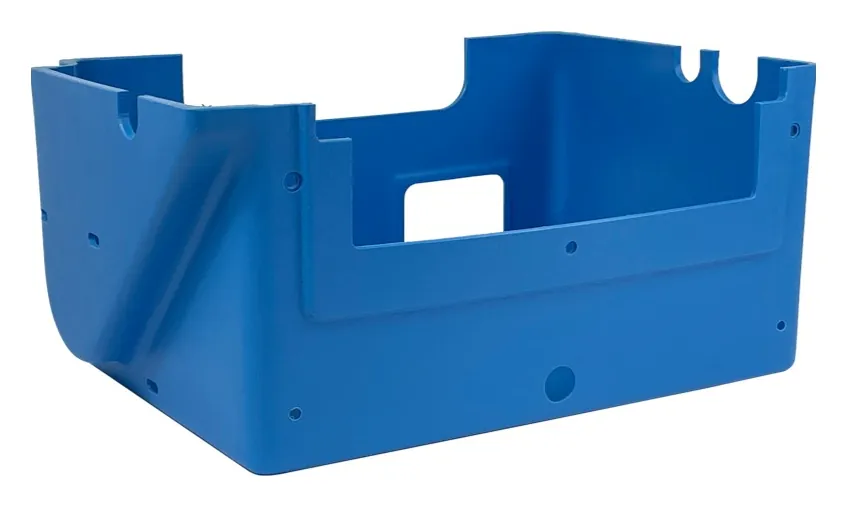
Vacuum forming is used for: Thin-gauge packaging trays, and heavy-gauge covers, enclosures, trays and panels like the parts Shirley K’s makes. See our custom vacuum forming services.
THERMOFORMING — THE BROADER CATEGORY
Thermoforming refers to any process that heats a plastic sheet and forms it over a mold. This includes:
- Vacuum forming (negative pressure only)
- Pressure forming (positive air pressure pushes sheet into mold for sharper detail)
- Matched mold forming (molds on both sides of the sheet)
- Heavy-gauge forming (thick plastic sheets for industrial applications)
For industrial OEM applications — enclosures, covers, trays, dunnage — heavy-gauge thermoforming with CNC trimming produces parts with the precision and durability that simple vacuum-formed packaging cannot achieve.
HEAVY GAUGE VS THIN GAUGE
A critical distinction often overlooked is the difference between thin-gauge thermoforming (packaging films, clamshells) and heavy-gauge thermoforming (industrial plastic parts). Shirley K’s specializes in heavy-gauge thermoforming.
Heavy Gauge vs Thin Gauge Thermoforming
SHIRLEY K’S THERMOFORMING CAPABILITIES
Shirley K’s performs heavy-gauge thermoforming for OEM industrial applications with in-house CNC trimming. Contact us to discuss your specific part geometry and material requirements.
Start a Custom Project
Call: (740) 868-8140
Common Questions About Vacuum Forming and Thermoforming
Is vacuum forming the same as thermoforming?
Vacuum forming is one method within thermoforming. Thermoforming is the umbrella term for any process that heats a thermoplastic sheet until it becomes pliable and then shapes it against a mold. Vacuum forming achieves that shaping by evacuating the air between the sheet and the mold, so atmospheric pressure presses the material into place.
What is the difference between vacuum forming and pressure forming?
Both begin with a heated sheet drawn against a mold. Vacuum forming relies on the pressure differential created by removing air. Pressure forming adds positive air pressure on the opposite face of the sheet, which drives the material into the mold with more force. The additional force generally allows sharper detail, tighter radii, and crisper texture.
What thickness of plastic can be vacuum formed?
Thermoforming is commonly divided into thin gauge and heavy gauge. Thin gauge generally refers to material fed from a roll and is typical of packaging. Heavy gauge refers to pre-cut sheet formed one part at a time, and is typical of structural components, enclosures, trays, and reusable containers.
When is vacuum forming a better choice than injection molding?
Vacuum forming generally becomes attractive for larger parts, lower annual volumes, and programs where tooling cost matters more than piece price. Thermoform tooling is usually single-sided and less expensive to produce than a matched injection mold. Injection molding generally wins at very high volumes and for small parts with thick or complex geometry.
What are the limitations of vacuum forming?
Because the sheet is drawn against one mold face, wall thickness varies with draw depth rather than staying uniform. Deep draws thin the material most at corners. Undercuts require tooling actions or secondary operations, and only one face of the part reproduces mold detail precisely.