

Material Handling Totes
Reusable HMW-HDPE plastic totes for material handling, warehouse, and distribution — stack-and-nest space savings, cross-stack ventilation, wire-bail stacking, dividers, ribbed-wall strength, and shipping designs built for repeated, heavy-duty use.
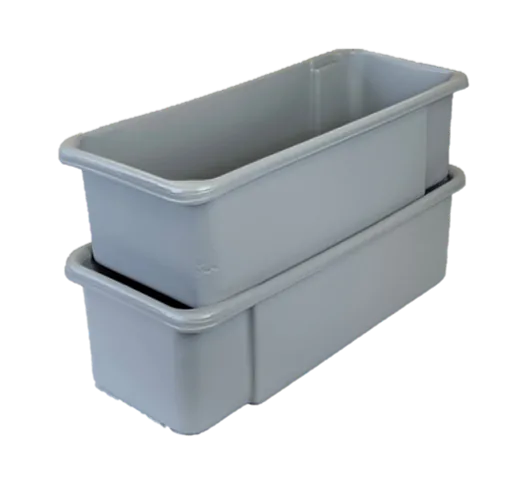
Rotate 180° to stack with product inside — nest when empty to save floor space. Multiple configurations available.
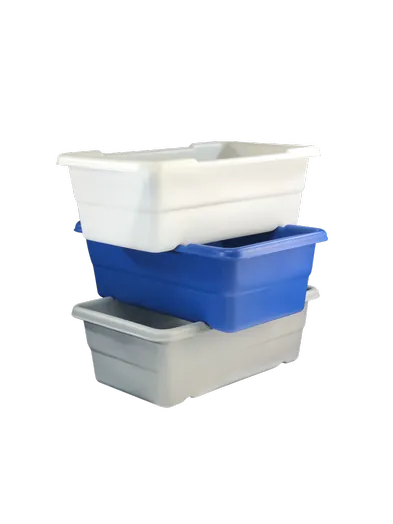
Rotate 90° to stack with product inside — nest when empty to save floor space.
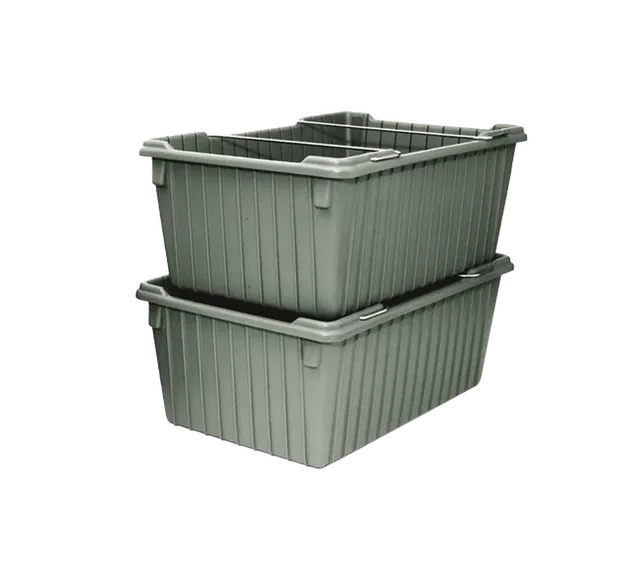
Stack with product inside by flipping the wire bail; flip it back to nest and save floor space.
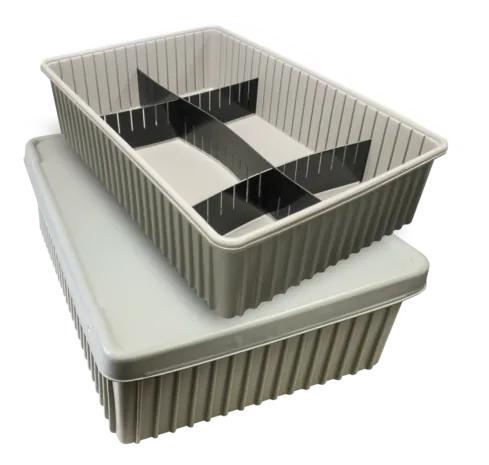
Totes with internal dividers for organized part storage and kitting.
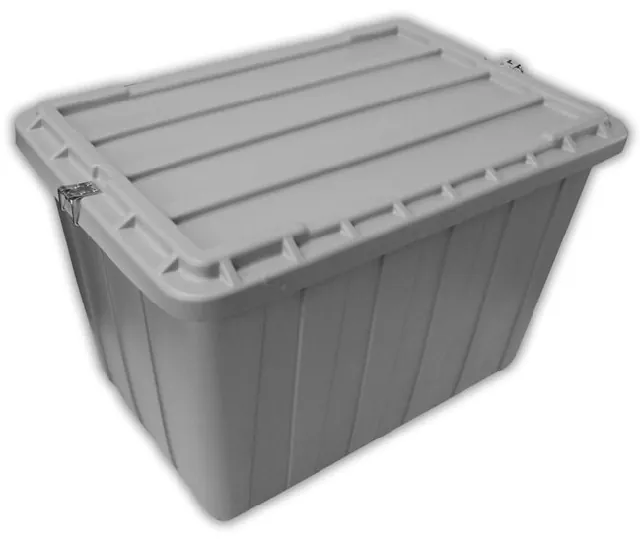
Large-capacity shipping totes (501–510 series). Available with lids, locking clasps, and casters.
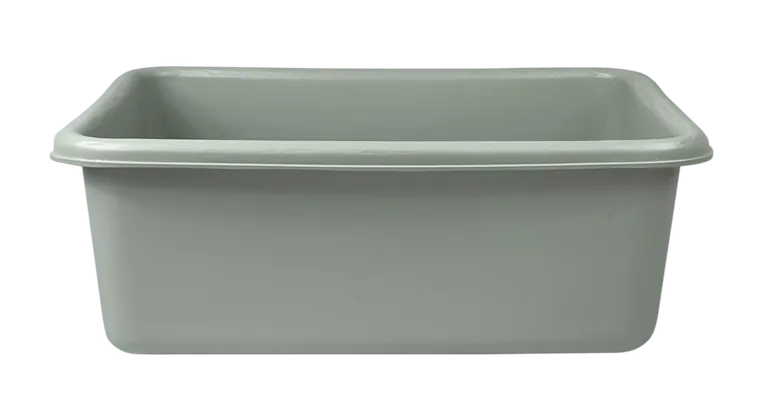
General-purpose tote configurations for warehouse and production use.
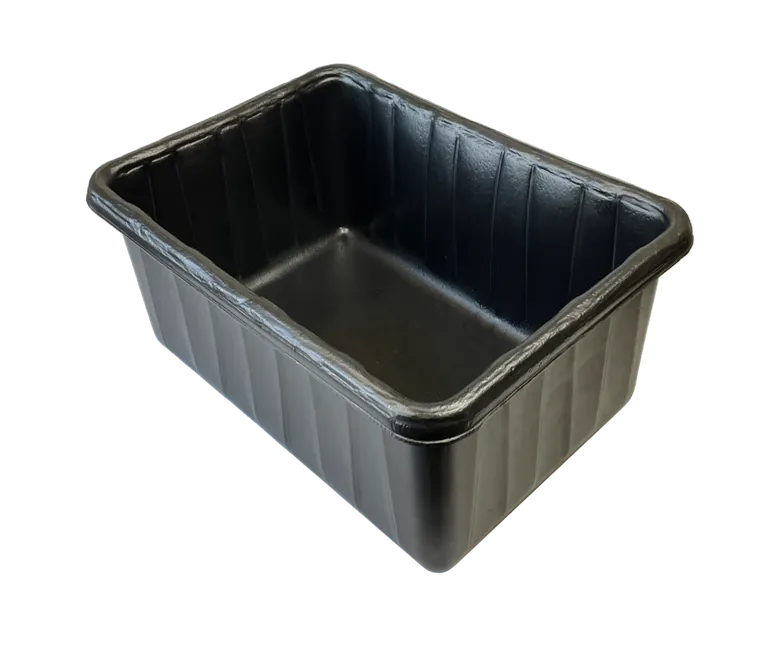
Ribbed-wall construction for additional structural rigidity under load.
Material Handling Tote Selection Notes
Shirley K’s manufactures reusable plastic totes for material handling, warehouse, and distribution applications — made from High Molecular Weight HDPE (HMW-HDPE) for heavy-duty construction designed for repeated, demanding use. We support reusable container programs where buyers need stack-and-nest space savings, cross-stack ventilation, wire-bail stacking options, divider configurations, ribbed-wall strength, and shipping tote designs for repeated plant, warehouse, logistics, and production use. Contact Shirley K’s to match tote style, dimensions, and material to the application.
Compared with injection-molded totes, our thermoformed HMW-HDPE containers offer superior strength, impact resistance, chemical resistance, and durability. Shipping totes are waterproof, corrosion-, chemical-, and wear-resistant with optional lids, locking clasps, and casters; tapered-wall totes nest 50–90% when empty to conserve storage space.
Many stock products available for fast shipment — contact Shirley K’s to confirm current availability and lead time.
Engineered for Extreme Duty
Shirley K’s material handling totes are thermoformed from High-Molecular-Weight HDPE (HMW-HDPE) — a material and process engineered to outlast standard injection-molded totes in cold storage, high-impact handling, and washdown environments.
Stays tough in the cold
Long, entangled polymer chains keep the material ductile in freezer and deep-cold service. A dropped tote dents instead of shattering — contents stay contained.
High impact resistance
Biaxial molecular orientation and near-zero residual stress spread impact across the whole part, not along one weak axis.
Resists chemical stress cracking
High ESCR stands up to sanitizers, animal fats, oils, and repeated washdowns — without the spider-web surface cracks common to injection-molded totes.
Safe, ductile failure
Instead of sudden brittle shattering (and sharp shards in food), HMW-HDPE flexes and dents while keeping its shape and containment — a higher safety margin for cold-chain and food.
| Property | Shirley K’s Thermoformed (HMW-HDPE) | Standard Injection-Molded HDPE |
|---|---|---|
| Molecular structure | Long, entangled chains — biaxial reinforcement | Shorter chains — primarily one direction |
| Residual stress | Near zero (low-pressure forming) | High (locked in by rapid cooling) |
| Cold-impact behavior | Ductile — flexes, dents, recovers | Brittle — sudden cracking near/below freezing |
| Chemical stress-crack resistance | Excellent ESCR | Moderate — accelerated by cold + chemicals |
| Failure mode | Visible denting, stays contained | Sudden shatter — possible shards |
Evaluated against recognized ASTM methods (D256 Izod impact, D746 brittleness temperature, D1693 / F2136 stress-crack resistance). Resin technical data sheets available on request — request specs or a quote.
Key Features
- Made from HMW-HDPE (High Molecular Weight High-Density Polyethylene) for enhanced impact resistance
- Rotate 180 degrees or 90 degrees to stack with product inside — nest when empty to save floor space
- Wire bail stacking option available (select models)
- Suitable for freeze operations — contact Shirley K’s for rated temperature range and product specifications
- Many stock products available for fast shipment — contact Shirley K’s to confirm current availability
Quote / Order
Request a Quote
Call: (740) 868-8140
Email: orders@shirleyks.com
Address: 1150 Newark Road, Zanesville, OH 43701
Related
- Food Handling Products
- Organizational Trays
- Custom Thermoforming
- Thermoformed vs Injection-Molded Totes
Common Questions About Plastic Material Handling Totes
What is the difference between stack-and-nest and cross-stack totes?
Stack-and-nest totes are designed so a container rotates to stack when loaded and nests inside another when empty. Cross-stack totes achieve the same result by rotating ninety degrees. Both approaches reduce the volume that empty containers occupy on a return trip.
Why do warehouses use reusable plastic totes instead of corrugated boxes?
Reusable containers survive repeated handling, hold their shape under load, can be washed, and remove the recurring cost and disposal burden of single-use packaging. The tradeoff is a higher upfront cost and the need to manage container return.
How is tote capacity measured?
Capacity is usually expressed as inside dimensions and as a volume figure. Inside dimensions matter most when a specific product must fit, while volume is more useful when estimating how much loose material a container will hold.
What is a wire bail tote used for?
Wire bail containers use metal handles that fold down, allowing containers to stack securely when the bails are raised and nest when they are lowered. The design is common where the same containers cycle repeatedly between storage and transport.