Thermoforming vs Injection Molding
Choosing between thermoforming and injection molding is one of the most common decisions OEM manufacturers face when sourcing custom plastic parts. Both processes produce durable plastic components — and thermoformed HMW-HDPE is more durable than injection-molded polypropylene — but they differ significantly in tooling cost, lead time, volume economics, and part geometry capability.
This guide explains both processes, compares them across key decision factors, and helps you determine which is the right fit for your project.
WHAT IS THERMOFORMING?
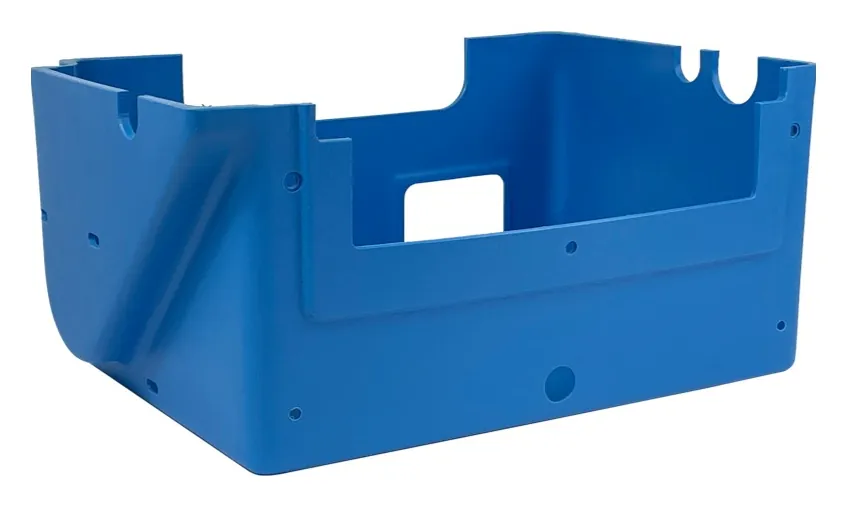
Thermoforming heats a flat plastic sheet until pliable, then forms it over a mold using vacuum or pressure, then trims the part to its final shape. Key characteristics:
- Lower tooling cost: Thermoforming tools are simpler than injection molds and significantly less expensive
- Shorter lead times: Tool development typically faster than injection molding
- Ideal for low-to-medium volumes: Economical for dozens to thousands of parts
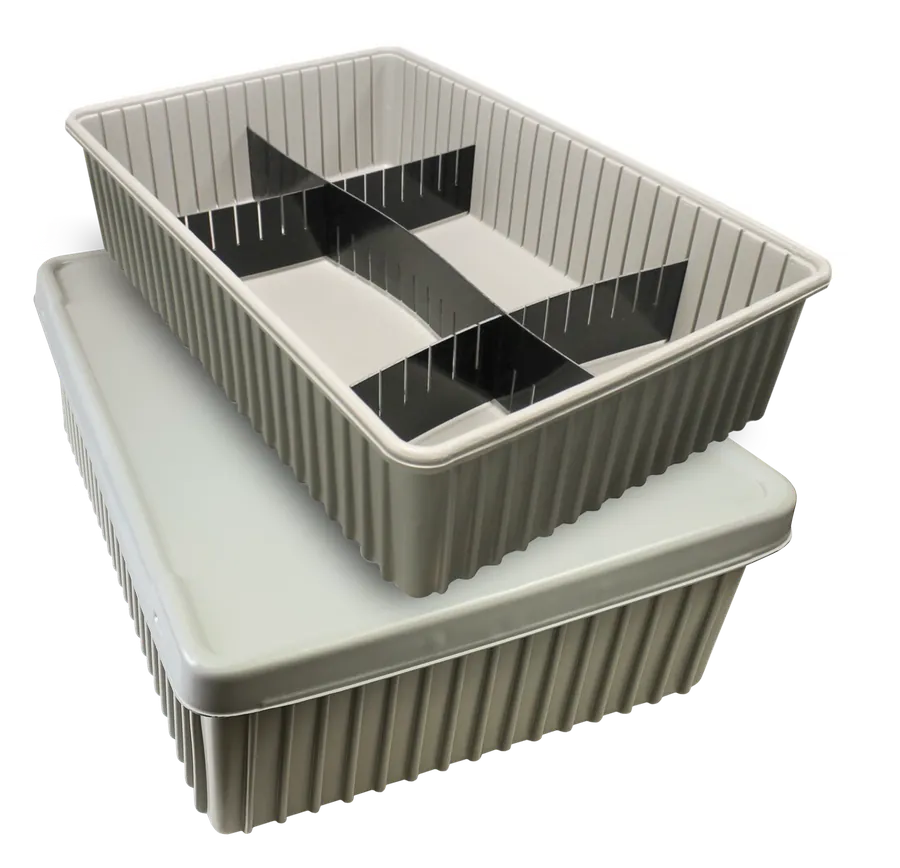
- Large part capability: Well-suited for large plastic parts (trays, enclosures, covers, housings)
- Material flexibility: Works with a range of thermoplastic sheet materials
WHAT IS INJECTION MOLDING?
Injection molding forces molten plastic into a closed mold under high pressure. Key characteristics:
- High tooling cost: Injection molds are expensive and complex
- Longer lead times: Tool design and fabrication takes longer
- Ideal for high volumes: Cost-effective when amortized over hundreds of thousands or millions of parts
- Complex geometry: Can produce undercuts, threaded inserts, and tight tolerances
- Consistent wall thickness: Better control over wall uniformity
COMPARISON TABLE
| Factor | Thermoforming | Injection Molding |
|---|---|---|
| Tooling cost | Lower | Higher |
| Lead time (new tool) | Shorter | Longer |
| Best volume range | Dozens to thousands | Hundreds of thousands to millions |
| Part geometry | Open shapes, large parts | Complex closed shapes, undercuts |
| Wall thickness control | Variable | More uniform |
| Material options | Thermoplastic sheet | Thermoplastic pellets |
| Part size | Excellent for large parts | Better for small complex parts |
The Material Science: Why Manufacturing Process Determines Performance
The performance difference between Shirley K’s thermoformed containers and standard injection-molded HDPE follows from how each process shapes the material at the molecular level.
Resin choice and chain entanglement
Thermoforming heats a pre-extruded HDPE sheet and vacuum forms it over a mold. Because the material does not need to flow through narrow gates and runners, the process can accommodate High-Molecular-Weight (HMW) HDPE resins with exceptionally long polymer chains. Those chains become deeply entangled during formation, creating a molecular network that resists crack initiation and propagation. Standard injection molding forces molten plastic into a cavity at high pressure through narrow gates, requiring lower-viscosity resins with shorter polymer chains and less molecular entanglement.
Biaxial orientation and near-zero residual stress
As the thermoformed sheet is stretched in multiple directions, it develops biaxial molecular orientation, reinforcing impact resistance across the part surface rather than primarily along a single axis. Because forming happens at relatively low pressure from a pre-relaxed sheet, the finished part carries near-zero internal stress. Injection-molded parts cool rapidly and unevenly, locking significant residual stress into the part and orienting the molecules primarily in one direction.
The ductile-to-brittle transition
All polyethylene loses impact resistance as it gets colder; the critical difference is where the material shifts from ductile behavior to brittle behavior. HMW-HDPE’s long, entangled chains maintain their ability to absorb and redistribute impact energy in sub-zero service, so a dropped container bruises or dents rather than shattering and maintains containment. Standard injection-molding-grade HDPE typically begins brittle behavior near or just below freezing.
The residual-stress factor
Cold environments cause all plastics to contract. In an injection-molded part already carrying internal tension from rapid cooling, that contraction adds to existing stress before any impact is applied. A dropped frozen tote experiences impact on top of thermal stress on top of molding stress. Shirley K’s thermoformed parts start from near-zero internal stress, allowing them to tolerate substantially more combined loading before failure.
Chemical stress-crack resistance and failure mode
ESCR measures resistance to cracking when mechanical stress and chemical agents act together. HMW-HDPE’s higher chain entanglement reduces the molecular free volume available for chemical ingress, helping Shirley K’s thermoformed containers resist slow-developing spider-web surface cracks under combined chemical, thermal, and mechanical stress. If failure occurs, the report describes the thermoformed HMW-HDPE mode as ductile: deformation, denting, or gradual tearing while maintaining overall structural integrity and containment.
WHEN THERMOFORMING WINS
Thermoforming is typically the right choice when:
- Volume is too low to justify injection molding tooling investment
- You need a domestic short-run supplier rather than a high-volume overseas program
- The part is large (trays, housings, covers, enclosures) rather than small and complex
- You need fast tooling and faster time-to-production
- You want to control tooling costs while the product design is still evolving
WHEN INJECTION MOLDING WINS
Injection molding is typically the right choice when:
- Volume is very high (hundreds of thousands or more per year)
- The part has complex geometry with undercuts or tight tolerances
- Uniform thin walls are required throughout the part
- Small, intricate parts that can’t be formed over a mold
Engineered for Extreme Duty
The performance gap between thermoformed HMW-HDPE and injection-molded HDPE comes down to material science — how the manufacturing process shapes the molecular structure, and the real-world durability that results.
Stays tough in the cold
Long, entangled polymer chains keep the material ductile in freezer and deep-cold service. A dropped tote dents instead of shattering — contents stay contained.
High impact resistance
Biaxial molecular orientation and near-zero residual stress spread impact across the whole part, not along one weak axis.
Resists chemical stress cracking
High ESCR stands up to sanitizers, animal fats, oils, and repeated washdowns — without the spider-web surface cracks common to injection-molded totes.
Safe, ductile failure
Instead of sudden brittle shattering (and sharp shards in food), HMW-HDPE flexes and dents while keeping its shape and containment — a higher safety margin for cold-chain and food.
| Property | Shirley K’s Thermoformed (HMW-HDPE) | Standard Injection-Molded HDPE |
|---|---|---|
| Molecular structure | Long, entangled chains — biaxial reinforcement | Shorter chains — primarily one direction |
| Residual stress | Near zero (low-pressure forming) | High (locked in by rapid cooling) |
| Cold-impact behavior | Ductile — flexes, dents, recovers | Brittle — sudden cracking near/below freezing |
| Chemical stress-crack resistance | Excellent ESCR | Moderate — accelerated by cold + chemicals |
| Failure mode | Visible denting, stays contained | Sudden shatter — possible shards |
Evaluated against recognized ASTM methods (D256 Izod impact, D746 brittleness temperature, D1693 / F2136 stress-crack resistance). Resin technical data sheets available on request — request specs or a quote.
WORKING WITH SHIRLEY K’S
Shirley K’s runs short and medium runs: quick change-over shuttle machines for low volumes and rotary machines for larger ones. If the cost of tooling is too high when amortized over the volume of parts because your volume is “too low,” thermoforming may be a better fit for your application.
Contact us to discuss your project. We’ll provide an honest assessment of whether thermoforming makes sense for your part geometry, material requirements, and volume.
Start a Custom Project
Call: (740) 868-8140